



Caravan Brake Controllers Explained: In-Cab vs Elecbrakes
If your caravan has electric brakes, they do nothing until something tells them to work. That something is the brake controller. Without one, your car is doing all the stopping for a van that may weigh as much as it does.
Here is why controllers exist, what the rules say, how the brakes and the controller work, and the four types you will come across.
Why brake controllers exist
A car’s brakes are built to stop the car, not a couple of tonnes of caravan pushing from behind. Caravan brakes share the load, keep the van in line behind you and shorten your stopping distance.
Lighter trailers often use override brakes, where the coupling pushes in as the car slows and applies the brakes mechanically. Most caravans use electric brakes instead. Electric brakes need a 12 volt signal to apply, and the controller is what sends it, in the right amount, at the right time.
Are they required?
Yes. In Queensland the rules work off the caravan’s GTM (the weight on its wheels). Not sure what GTM means? See our guide to caravan towing weights.
| Caravan GTM | What is required |
|---|---|
| Up to 750 kg | No brakes required |
| 751 kg to 2,000 kg | Brakes on at least one axle. Override brakes are allowed |
| Over 2,000 kg | Brakes the driver can operate from the seat, plus a breakaway system that applies them if the van comes off the car |
The part that matters here: any brakes other than override brakes must be able to be operated from the driver’s seat. For electric brakes, that means a controller you can adjust and apply while seated.
How electric caravan brakes work
Electric caravan brakes are drum brakes with a magnet doing the job that hydraulic fluid does in a car.
- Inside each brake drum sits an electromagnet, mounted on a lever arm.
- When the controller sends power down the brake wire, the magnet switches on and grabs the inside face of the spinning drum.
- The drum drags the magnet around with it, which swings the lever arm.
- The lever arm pushes the brake shoes out against the drum, and the wheel slows.
More power means a stronger magnet, more drag and harder braking. Less power means gentler braking. So the brakes themselves are simple. How well they work comes down to how well the controller decides the amount of power to send.
How a brake controller works
Every controller does three jobs:
- Senses that you are braking. Usually from the brake light signal.
- Decides how much power to send. This is where the types differ.
- Lets the driver take over. You can turn the braking force up or down to suit the load, and apply the caravan brakes on their own with a manual override. The override is what you reach for if the van starts to sway.
The four types of brake controller
1. Old drawbar-mounted units (not recommended)
These early units sit on the caravan drawbar and work out the braking on their own, with no control in the car. The driver cannot adjust them on the move or apply the van brakes by hand.
That is the problem. Electric brakes need to be operable from the driver’s seat, and these are not. If your van still has one, we recommend replacing it.
2. Basic in-cab controller (on/off style)
This is the standard unit many of us grew up with: a dial under the dash. When you touch the brake pedal, it sends the amount of power you have set on the dial, whether you are braking gently or hard.
It meets the rules, and it is simple and reliable. The downside is that it has no idea how hard you are braking. A light touch at a roundabout and a full emergency stop both get the same set amount.
In practice that means the van often brakes too hard at slow speeds around town, grabbing and jerking the car. Then on the highway, or in an emergency, the same setting is not enough and the car is left doing most of the work.
The only fix is the dial. Drivers end up reaching down to adjust it again and again, turning it down for town and up for the open road, trying to compensate. It works, but it relies on you getting it right before you need it.
3. Inertia-sensing in-cab controller
Newer in-cab units, such as the Redarc Tow-Pro Elite, measure how hard the car is actually slowing and brake the caravan to match. Brake gently and the van brakes gently. Stand on the pedal and the van brakes hard. This is called proportional braking.
The Tow-Pro Elite also has a user-controlled mode, where it applies a fixed level you set, for slow off-road work. Its small control knob mounts in the dash with the main unit hidden behind.
This fixes the big weakness of the basic controller. There is no reaching for the dial between town and highway. Most importantly, in an emergency stop the caravan brakes harder automatically, at the moment you need it most.
For a controller wired into the car, this is the type to have. We keep the Tow-Pro in stock. Because it is wired into the vehicle, it needs to be fitted by an auto electrician, so allow for that. The unit itself costs less than an Elecbrakes, but by the time it is fitted it usually ends up the dearer option.
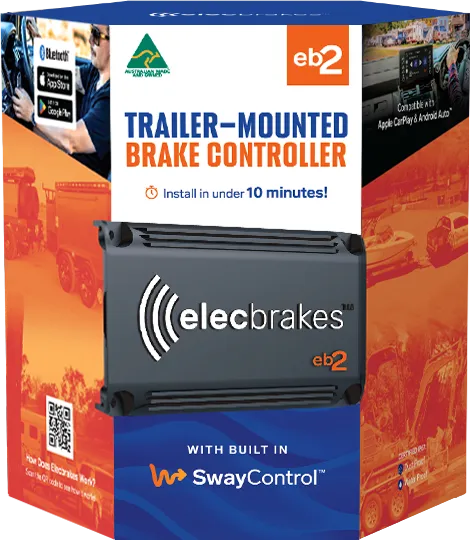
4. Elecbrakes (caravan-mounted, wireless control)
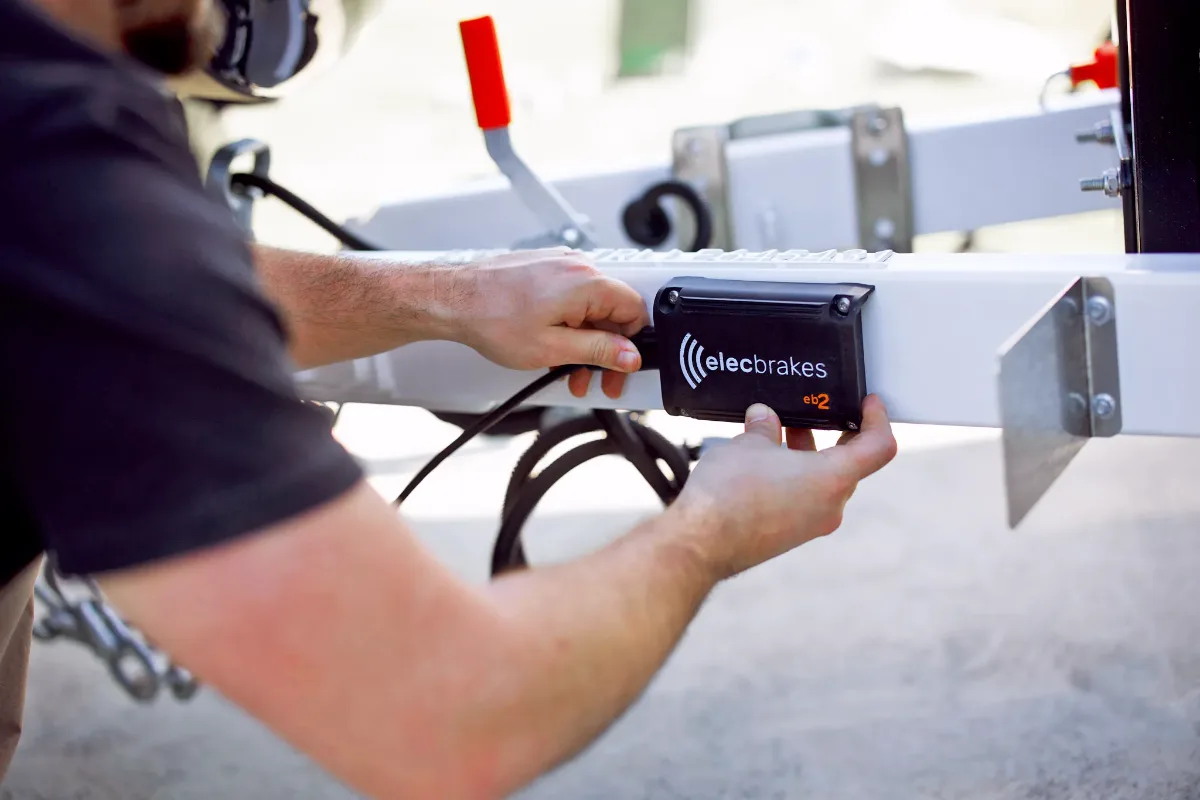
Elecbrakes turns the idea around. The controller mounts on the caravan drawbar and wires or plugs into the caravan’s own wiring. Nothing is wired into the car.
Watch: how Elecbrakes works
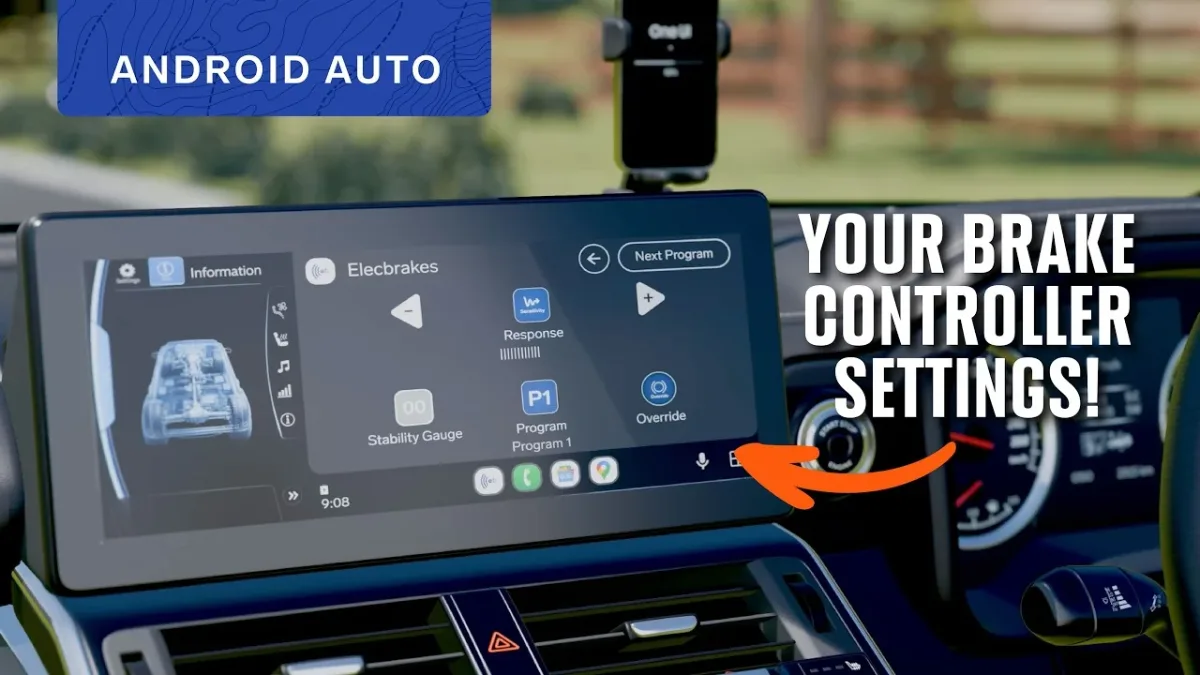
It is a proportional controller: it senses how hard the rig is slowing and brakes the van to match. The difference from the old drawbar units is that the driver has full control from the seat, through a phone app, Apple CarPlay or Android Auto, or a small in-car remote. You can change the braking level, switch between saved programs and use the manual override.
It also does a lot more than a standard brake controller:
- Built-in sway control. The unit watches the caravan’s side-to-side movement and applies the van’s brakes automatically to settle sway, before the driver has time to react. It comes standard, with no extra hardware to buy or fit.
- Stability gauge. The app shows how stable the van is as you drive, so you can ease off before sway starts.
- Five braking programs. Save a setup for each situation, such as loaded, empty, highway or gravel, and switch between them in a tap.
- On your car’s screen. Works through Apple CarPlay and Android Auto, so the controls sit on the dash display.
- Live diagnostics. The app shows what the brakes are doing in real time, which helps pick up a brake or wiring fault early.
- Updates over the air. New features arrive through the app. Sway control itself was added to existing units this way, free.
- Built for the drawbar. IP67 rated: dust, water and shock proof.
- Works with both brake types. Electric and electric-over-hydraulic.
- Australian designed and made, on the NSW Central Coast, with a 2 year warranty.
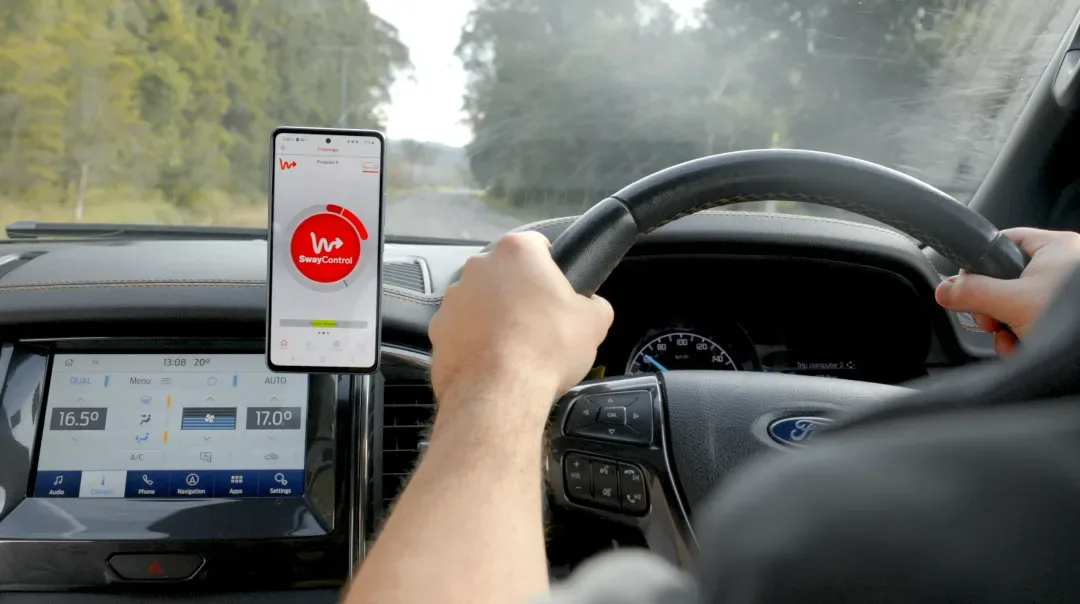
Watch: the Elecbrakes app and sway control

This is the system we stock, sell and fit at Searle’s RV Centre. See our Elecbrakes brake controllers page for the full details.
In-cab or Elecbrakes: pros and cons
Both do the job well. The choice comes down to how you tow.
| Inertia-sensing in-cab controller | Elecbrakes on the caravan | |
|---|---|---|
| Where it lives | Wired into the car | Mounted on the caravan |
| Fitting | Wired through the car by an auto electrician, once per vehicle | Easy to fit yourself, or fitted and test towed by our workshop. No changes to the car |
| Overall cost | Lower price for the unit, but usually dearer once fitted | Higher price for the unit, little or no fitting cost |
| Sway control | Not included | Built in as standard |
| Change tow vehicles | The new car needs its own controller | Hook up and go with any car that has a standard trailer plug |
| Tow other trailers | Works with any trailer with electric brakes | Each van or trailer needs its own unit |
| Driver control | Fixed knob in the dash, always in the same spot | Phone app, CarPlay or Android Auto, or the in-car remote |
| Relies on | The car’s wiring | Bluetooth, plus your phone or the remote |
| Settings | Set in the car for whatever is behind it | Five programs saved on the van, so they suit that van every time |
| Extras | None | Stability gauge, live diagnostics, over-the-air updates |
A few things to know about Elecbrakes before you buy:
- The manual override needs the app open or the remote in reach. Phone rules while driving apply, so we suggest the remote.
- It is designed for up to two braked axles.
- Some vehicles need an extra power feed at the trailer plug.
Our pick
These days we think Elecbrakes is the superior system for most caravanners. You get smooth proportional braking and built-in sway control in one unit, and at the time of writing in-cab controllers do not have sway control built in. It stays with the van, so it works whether you tow with your own car, a new car, or a mate’s. There is nothing to wire into a modern vehicle, no auto electrician to pay, and the braking is set up for that caravan, not for whatever the car towed last.
An in-cab unit still makes sense if one vehicle tows several different trailers, or if you want a fixed knob on the dash and no phone or Bluetooth involved.
Do not forget the brakes themselves
The best controller cannot make up for worn or badly adjusted brakes. Magnets, shoes and drums all wear, and electric brakes need adjusting from time to time to keep pulling up evenly.
Our workshop carries out mechanical servicing on most makes and models of caravans, and the brakes are checked and adjusted as part of it. See what is involved in caravan servicing at Searle’s RV Centre, or read our caravan service checklist.
Elecbrakes at Searle’s RV Centre
Ready for smoother, safer towing?
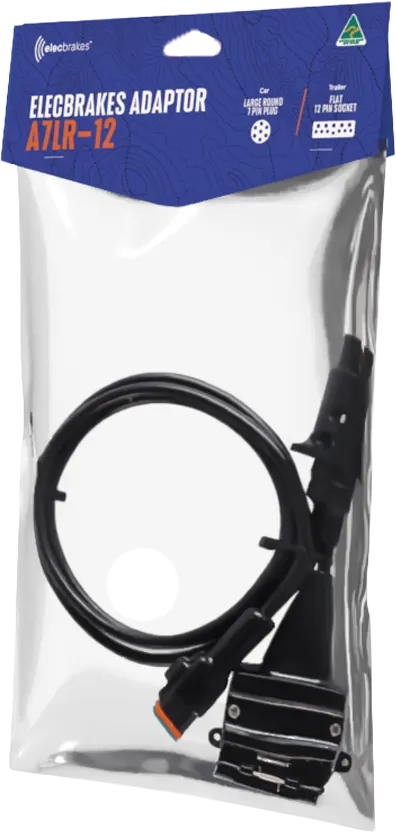
We keep Elecbrakes controllers, adaptors and remotes in stock in Bundaberg. Fit it yourself in minutes, or have our workshop fit it and set it up with you on a test tow.
Frequently asked questions
Do I need a brake controller to tow a caravan?
If the caravan has electric brakes, yes. The brakes will not work without one, and the driver must be able to operate them from the seat.
What is the difference between a basic and a proportional brake controller?
A basic controller sends the same set amount of power every time you brake. A proportional controller senses how hard the car is slowing and brakes the caravan to match, which is smoother and safer.
Can a brake controller be mounted on the caravan instead of in the car?
Yes. Elecbrakes mounts on the caravan drawbar and is controlled from the driver’s seat by phone app or in-car remote. Older drawbar units with no in-car control are not recommended.
Will Elecbrakes work with any tow vehicle?
It works with vehicles that have a standard trailer plug, with no changes to the car. Some vehicles need an extra power feed at the plug.
Does a brake controller help with caravan sway?
A standard controller only helps if the driver reaches for the manual override in time. Elecbrakes has sway control built in. It senses the van starting to sway and applies the caravan brakes automatically to bring it back into line.
Elecbrakes or Redarc Tow-Pro: which is better?
Both give smooth proportional braking. The Tow-Pro suits one vehicle that tows several different trailers and needs fitting by an auto electrician. Elecbrakes stays with the caravan, works with any tow vehicle, needs no wiring in the car and has sway control built in. For most caravanners we recommend Elecbrakes.
Where can I get Elecbrakes fitted in Bundaberg?
Searle’s RV Centre stocks Elecbrakes units, remotes and adaptors, and fits them in our own workshop. Call 07 4151 3000.
How do I set the braking level?
Set it so the caravan brakes gently without locking its wheels, then adjust for load and road surface. Test at low speed on a quiet road each time the load changes.
A decent dealer will set up your electric brakes with you on a complimentary tow test when you collect a caravan you have bought from them. We do this for every customer. Not all dealerships do, and they should.
How do I know which controller my rig has now?
Look for a dial or knob near the driver’s knee or in the dash, or a small box on the caravan drawbar. If you are not sure, give us a call on 07 4151 3000.