





Caravan Service Checklist: What Gets Checked, How Often and Pre-Trip Tips
Most caravan and motorhome manufacturers want a regular inspection, commonly once a year or after a set distance, whichever comes first. A proper service checks the parts that fail on the road: wheel bearings, brakes, tyres, suspension, hitch and coupling, gas, 12V electrics, water system, seals and the body. Your owner’s handbook and warranty terms have the final say on timing.
A caravan or motorhome sits still for months, then covers hundreds or thousands of kilometres over highways, back roads and boat ramps. That’s a hard life for any machine. Here’s what a good service covers, why skipping it can cost more than doing it, and how to avoid the classic breakdowns.
Why servicing matters more than most owners think
- Safety. Brakes, bearings, tyres and couplings are the components you least want to fail at 100 km/h.
- Warranty. Manufacturers generally require inspections on a regular basis as part of their warranty. Miss them and a claim can become complicated.
- Cost. A dry bearing or a small leak is a minor job. Left alone, it becomes a major repair, or a ruined trip.
- Resale value. A stamped service history is among the first things a buyer asks for. See our guide to selling your caravan.
What a caravan service typically covers
Exactly what’s included varies by workshop and van, so ask for a checklist when you book. A thorough service usually looks at the following.
| System | What gets checked | Why it matters |
|---|---|---|
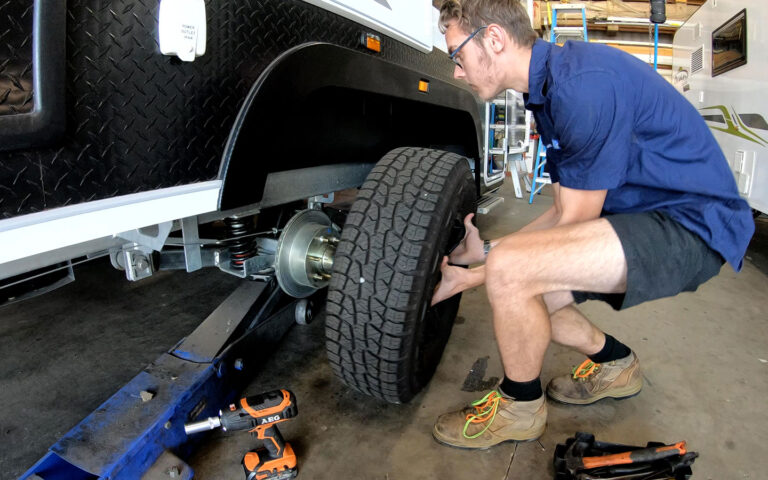
| Wheels, bearings and brakes | Wheel bearings, brake shoes or pads, magnets and wiring, wheel nuts, hub condition | Brake and bearing failures are among the most serious problems on the road |
| Tyres | Tread, sidewall condition, pressure, spare | Tyres carry the whole van, so their condition and pressure matter |
| Suspension and chassis | Springs, shackles, bushes, shock absorbers, welds, rust | Rough roads and potholes punish these parts |
| Coupling and drawbar | Coupling, safety chains, jockey wheel, brake-away system | This is what holds the van to the car |
| Gas system | Regulator, hoses, fittings, leak test | Gas should be checked by a qualified person |
| Electrical | 12V battery and charger, fuses, lights, solar and wiring | Faults here can leave you without power, or cause worse |
| Water system | Pump, filters, tanks, taps, hoses, hot water | Prevents leaks and keeps your water clean |
| Body and seals | Roof and window seals, hatches, doors, signs of water ingress | Water getting in is the most expensive kind of caravan damage |
How often should you service a caravan or motorhome?
There’s no single answer. A typical rule of thumb is once every 12 months or after a set number of kilometres, but your manufacturer’s handbook and warranty set the real schedule. Consider an extra check if:
- you’ve done a big trip or a lot of kilometres since the last service;
- the van has been sitting for a long time;
- you’ve bought a second-hand van and don’t know its history;
- you’ve noticed a change in handling, braking, noises or smells.
Motorhome owners
The base vehicle needs to be serviced by a mechanical workshop approved by its manufacturer, using approved fluids and parts, to keep the vehicle warranty. The habitation side, such as gas, water and 12V, is a separate job for an RV workshop.
Your pre-trip checklist (10 minutes that can save a holiday)
- Tyres: check pressures cold, inspect sidewalls, and confirm the spare is ready.
- Wheel nuts: check they’re tight, especially after any wheel removal.
- Lights and indicators: test brake lights, indicators and running lights with a helper.
- Coupling and chains: check the coupling is latched, safety chains are attached and the brake-away cable is connected.
- Brake controller: test it before you set off.
- Gas: check bottles are secure, valves are off while driving, and there is no gas smell.
- 12V: make sure the battery is charged.
- Water: check tanks, taps and any leaks before you fill.
- Latches and hatches: close and lock every cupboard, door, window and roof hatch.
Five warning signs not to ignore
- A burning smell or hot hub after a drive: could be a bearing or brake issue.
- The van pulling to one side under braking.
- Persistent sway or “float” at highway speeds.
- Damp patches, soft spots or a musty smell inside.
- Gas smell, or a gas flame burning yellow instead of blue.
If you notice any of these, stop, get it checked and don’t wait for the next scheduled service.
Servicing, warranty and insurance repairs in Bundaberg
Our Bundaberg workshop handles caravan servicing, warranty repairs and insurance repairs. If you can’t get to Bundaberg, use any reputable caravan or RV service centre near you: the important thing is that it’s done and documented.
Frequently asked questions
Most manufacturers recommend an inspection at least once a year or after a set distance, whichever comes first. Check your owner’s handbook and warranty terms for your van’s schedule.
A thorough service typically checks wheel bearings, brakes, tyres, suspension, coupling, gas, 12V electrics, the water system, seals and the body. Ask your workshop for a checklist.
Manufacturers generally require regular inspections as a condition of warranty. Check your warranty documents for the specific requirements.
Yes. Our Bundaberg workshop services caravans, campers and RVs, and also handles warranty and insurance repairs. Motorhome base vehicles need an approved mechanical workshop to keep the vehicle warranty.
Call 07 4151 3000 or use the online form on our servicing page. We’re open Monday to Friday 8am to 5pm and Saturday 8:30am to 12pm.
Due for a service?
Book your van into our Bundaberg workshop and head off knowing it’s been checked.
Book a caravan service or call 07 4151 3000