




Caravan Towing Weights Explained: ATM, GTM, GVM, GCM and Tow Ball Weight
To tow a caravan legally and safely you need to check four numbers: the caravan’s tare plus real-world load (with its ATM as the ceiling), your vehicle’s braked towing capacity, the tow ball weight against your towbar and vehicle limits, and your vehicle’s GVM and GCM once you’ve added passengers, gear and the van. If any one of them is exceeded, the combination is overloaded, no matter how good the other three look.
Towing weights have a reputation for being confusing, mostly because the acronyms all look alike. They’re not hard once you see how they fit together. Here’s the plain-English version, the same walk-through we give customers at the counter in Bundaberg.
The weight terms, in plain English
| Term | What it means | Where to find it |
|---|---|---|
| Tare | The weight of the caravan empty: water tanks and gas bottles empty, but factory-fitted items such as batteries included. | Caravan compliance plate |
| ATM (Aggregate Trailer Mass) | The maximum total weight of the fully loaded caravan, not hitched to anything. This is your van’s weight ceiling. | Caravan compliance plate |
| GTM (Gross Trailer Mass) | The weight carried on the caravan’s axles when it is hitched to the tow vehicle. Slightly less than ATM, because some weight sits on the tow ball. | Caravan compliance plate |
| Tow ball weight | The downward force the drawbar puts on the tow ball. Often called ball weight or tow ball download. | Caravan compliance plate; measure it with the van loaded |
| GVM (Gross Vehicle Mass) | The maximum loaded weight of your tow vehicle, including passengers, luggage, accessories and the tow ball weight. | Vehicle compliance plate or owner’s manual |
| GCM (Gross Combination Mass) | The maximum combined weight of the loaded vehicle and loaded caravan together. | Vehicle owner’s manual |
| Braked towing capacity | The most your vehicle is rated to tow with a braked trailer. It needs an electric brake controller in the vehicle for caravans with electric brakes. | Vehicle owner’s manual |

Step 1: Start with the caravan’s tare, then know its ATM
The brochure weight is usually the tare, which is the empty van. That is your starting point. Your real travelling weight is the tare plus everything you load: water, gas, bedding, food, bikes and the rest, and those add up faster than most people expect. The ATM is the maximum the van is allowed to be loaded to, so it is the ceiling, not a prediction. Plan around your real loaded weight, and use the ATM to know how far the van could go.
Step 2: Check the vehicle’s towing capacity and towbar
Your vehicle’s braked towing capacity is in the owner’s manual. Compare it with your caravan’s real loaded weight (tare plus what you carry). Many dealers and insurers like to see the ATM at or under that figure, because it is the weight the van can reach. If your ATM is higher, you are relying on never loading the van past what your vehicle can tow, so weigh it fully loaded to be sure. If your vehicle and towbar have different ratings, the lower figure rules. A towbar that is rated lower than the car is the limit, full stop.
Leave yourself a buffer
Many experienced towers aim to keep the loaded caravan comfortably below the vehicle’s maximum, with a margin of roughly 10 to 20 per cent. A van that sits right at the limit leaves no room for the headwind, the hill or the extra water you decide to carry.
Step 3: Get the tow ball weight right
The tow ball weight keeps the combination stable. Too little and the van can sway. Too much and it overloads your vehicle’s rear axle and lifts weight off the front wheels. A commonly quoted range is around 8 to 12 per cent of the caravan’s loaded weight, although some vans are designed to run a lighter tow ball weight. The real answer is whatever the caravan’s compliance plate and your vehicle and towbar allow.
- Measure it with the van loaded the way you travel, not empty in the driveway.
- Heavy items such as water tanks and gear should sit low and close to the axle.
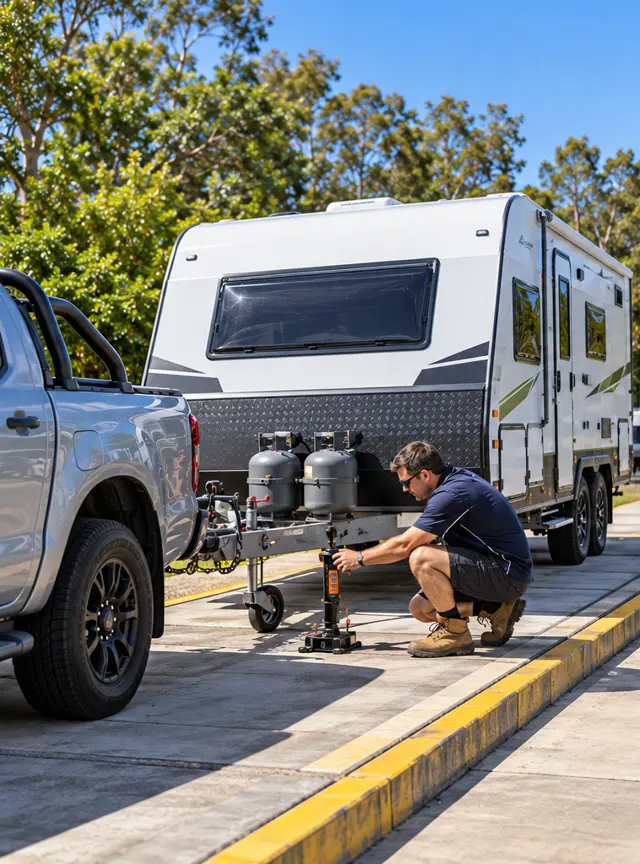
- Remember the tow ball weight is carried by your tow vehicle, not the caravan. It counts toward the vehicle’s GVM and eats into the car’s payload, so it uses up space you might want for passengers and gear.
Step 4: Don’t forget the vehicle’s payload (GVM)
This is the sleeper. Plenty of rigs are within the towing capacity but over the vehicle’s GVM. Add up the driver, passengers, dog, roof racks, bull bar, canopy, fridge, recovery gear and tow ball weight. That total has to stay at or under the GVM on the vehicle’s plate. A heavy tow ball weight plus a loaded 4WD can reach that limit faster than most people expect.
Step 5: Check the combined weight (GCM)
The GCM is the final check. Loaded vehicle plus loaded caravan must not exceed the manufacturer’s maximum combination weight. Because it counts everything, GCM is often the first limit people hit, particularly with a heavy van behind a mid-size ute or SUV.
A worked example (with made-up numbers)
These figures are for illustration only. Always use the ones on your own plates and in your own manual.
- Caravan travelling weight (tare plus load): 2,800 kg
- Vehicle braked towing capacity: 3,500 kg. The van is under the limit with a healthy buffer. ✅
- Tow ball weight at 10 per cent: roughly 280 kg. This must be within the van’s plate, the towbar’s rating and the vehicle’s limits. ✅
- Vehicle GVM allows a payload; passengers, gear and 280 kg of ball weight must all fit within the car’s payload. ⚠️ This is the one that catches people out.
- GCM: vehicle (loaded) plus 2,800 kg must be under the vehicle’s GCM. ⚠️
The van passes the towing-capacity test and still might fail on GVM or GCM. That’s why you need to check all four.
Why this matters beyond the fine
- Safety. Overloaded combinations brake poorly and are more prone to sway.
- Insurance. If you are involved in an incident and the rig is over its limits, your insurer may take a dim view. It’s worth reading your policy. See our caravan insurance page for the basics.
- Wear and tear. Tyres, brakes, suspension and drivetrain all pay the price of running at or over their limits.
Practical tips before your next trip
- Photograph your caravan’s compliance plate and keep it on your phone.
- Weigh the rig fully loaded at a public weighbridge at least once.
- Fit a quality electric brake controller and set it up for your van.
- Check the tyre pressures and ratings on both the vehicle and van.
- Pack heavy items low and over the axle, and keep the load balanced side to side.
- Ask your dealer to check the match before you buy, not after.
Buying a van? Start with the tow vehicle
If you are choosing a new caravan, work backwards from the vehicle you already own. Tell us what you drive and how you travel, and we’ll show you vans that sit comfortably inside your limits. Browse our Willow RV range or current stock, or get in touch.
Frequently asked questions
ATM is the maximum total weight of the loaded caravan when it is not attached to a tow vehicle. GTM is the weight carried by the caravan’s axles when it is hitched, so it is lower than ATM by roughly the amount resting on the tow ball.
A commonly quoted guide is around 8 to 12 per cent of the loaded caravan weight, although some vans are designed to run lighter. The real limit is set by the caravan’s compliance plate, your towbar rating and your vehicle’s manual. Always check all three.
Use both. Tare is the starting point, and your real travelling weight is the tare plus everything you load. ATM is the ceiling the van is allowed to reach. Match the vehicle to your real loaded weight, and weigh the van fully loaded to confirm it.
It is the maximum weight your vehicle is rated to tow with a braked trailer. Caravans with electric brakes need a brake controller fitted in the tow vehicle.
It can work if your real loaded weight always stays within the vehicle’s rated towing capacity, but you are relying on never loading the van past that point. Weigh it fully loaded, use the lower of your vehicle and towbar ratings, and check with your vehicle manufacturer and insurer first.
Yes. Tow ball weight is carried by the tow vehicle, so it counts toward the vehicle’s GVM along with passengers and luggage. It uses up the car’s payload, not the caravan’s.
Not sure your rig adds up?
Bring your vehicle details and we’ll help you match a caravan to what you already tow.
Talk to the team or call 07 4151 3000This article is general guidance only. Always rely on your vehicle manufacturer’s figures, your compliance plates and, where needed, your state transport authority.